February 5, 2024
Paper has an endless list of uses. Whether it’s a matte paper used for drawing or a glossy paper for a leaflet, each style of paper has a host of different weights, measurements, standards and more, which can be hard to wrap your head around.
This guide explains the differences between paper types so that you can ensure you are choosing the right paper for your intended use.
Paper sizes – explained
As standard, today there are two accepted paper sizing systems – the North American system and the international system. There are a few lesser-known standards such as ANSI which are used in certain circles but are nowhere near as popular.
Sometimes you might come across a paper size you aren’t familiar with, or you may need to choose the right sized paper for poster printing or artwork. Below, we discuss the differences in standards and show you the size conversions for the most common paper standards.
IS0 216 – International Standard
The international standard for paper is known as the ISO 216 standard (previously known as DIN 476). This system was first conceptualised in 1786 by German scientist Georg Christoph Lichtenberg and some of the ISO formats we know today (A2, A3, B4 & B5) were developed later on in France. Today, the most common ISO standard that we use is A4. The measurements for the standard are based on the following:
The easiest way to visualise the paper’s size in your mind is remembering that the number of the format goes up as the sizing goes down. Each paper size is always half the size of the number standard above it, for example. A2 is half the size of A3, and A2 is half the size of A1.
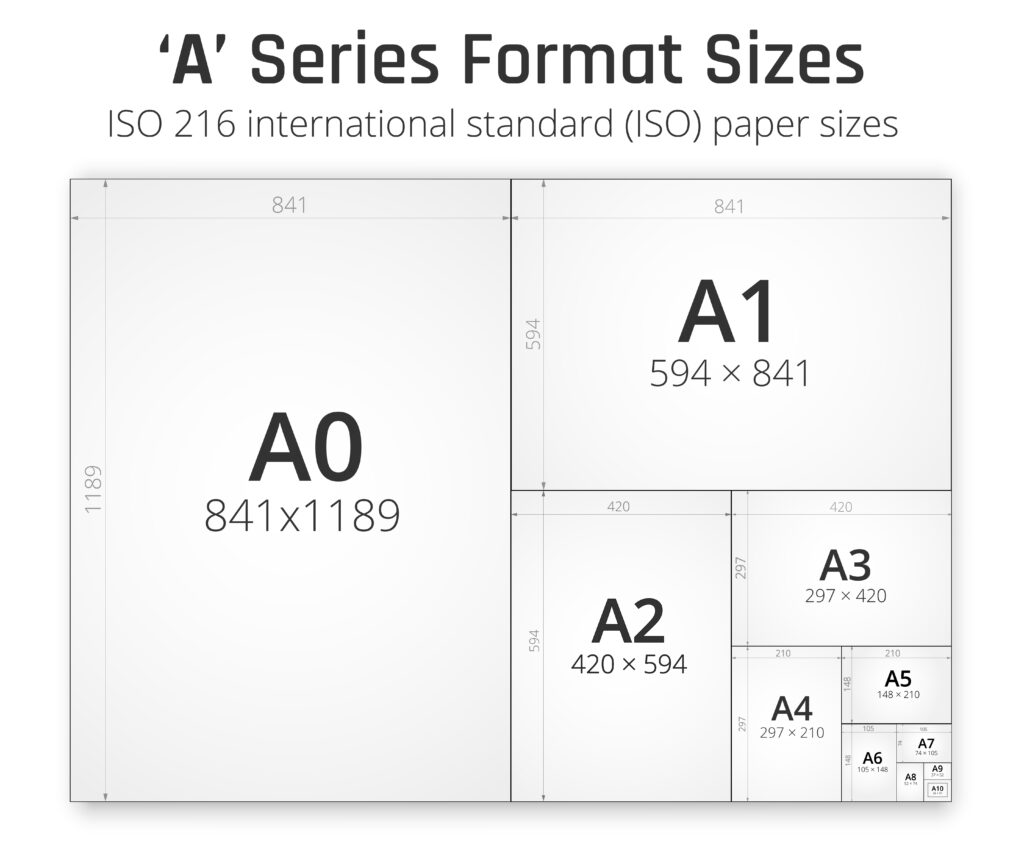
IS0 216 – ‘A’ Series
The following table shows conversions for ‘A’ format paper:
Format | Inches | Centimetres | Millimetres |
A0 | 33.1 x 46.8 in | 84.1 x 118.9 cm | 841 x 1189 mm |
A1 | 23.4 x 33.1 in | 59.4 x 84.1 cm | 594 x 841 mm |
A2 | 16.5 x 23.4 in | 42.0 x 59.4 cm | 420 x 594 mm |
A3 | 11.7 x 16.5 in | 29.7 x 42.0 cm | 297 x 420 mm |
A4 | 8.3 x 11.7 in | 21.0 x 29.7 cm | 210 x 297 mm |
A5 | 5.8 x 8.3 in | 14.8 x 21.0 cm | 148 x 210 mm |
A6 | 4.1 x 5.8 in | 10.5 x 14.8 cm | 105 x 148 mm |
A7 | 2.9 x 4.1 in | 7.4 x 10.5 cm | 74 x 105 mm |
A8 | 2.0 x 2.9 in | 5.2 x 7.4 cm | 52 x 74 mm |
A9 | 1.5 x 2.0 in | 3.7 x 5.2 cm | 37 x 52 mm |
A10 | 1.0 x 1.5 in | 2.6 x 3.7 cm | 26 x 37 mm |
ISO 216 – ‘B’ Series
The following table shows conversions for ‘B’ format paper
Format | Inches | Centimetres | Millimetres |
B0 | 39.4 × 55.7 in | 100.0 x 141.4 cm | 1000 × 1414 mm |
B1 | 27.8 × 39.4 in | 70.7 x 100.0 cm | 707 × 1000 mm |
B2 | 19.7 × 27.8 in | 50.0 x 70.7 cm | 500 × 707 mm |
B3 | 13.9 × 19.7 in | 35.3 x 50.0 cm | 353 × 500 mm |
B4 | 9.8 × 13.9 in | 25.0 x 35.3 cm | 250 × 353 mm |
B5 | 6.9 × 9.8 in | 17.6 x 25.0 cm | 176 × 250 mm |
B6 | 4.9 × 6.9 in | 12.5 x 17.6 cm | 125 × 176 mm |
B7 | 3.5 × 4.9 in | 8.8 x 12.5 cm | 88 × 125 mm |
B8 | 2.4 × 3.5 in | 6.2 x 8.8 cm | 62 × 88 mm |
B9 | 1.7 × 2.4 in | 4.4 x 6.2 cm | 44 × 62 mm |
B10 | 1.2 × 1.7 in | 3.1 x 4.4 cm | 31 × 44 mm |
North America Standards
This system is used primarily in the United States, the Philippines and Canada. The most common sizes of this standard are Tabloid/Ledger, Letter and Legal. Not much is known about how these standards came about, but they are used to describe both digital and physical formats.
Format | Size in Inches | Size in Millimetres |
Junior Legal | 8 x 5 | 203 x 127 |
Letter | 8.5 x 11 | 216 x 279 |
Legal | 8.5 x 14 | 216 x 356 |
Tabloid (Ledger) | 11 x 17 | 279 x 432 |
The names here are self-descriptive, and the most widely used format is the Letter format.

Established in 1998, we have been providing graphic design and print services for over 20 years. Based in the South West of England (Exeter, Devon) we have worked with clients, large and small, from all over the world and across a variety of sectors.

Welcome to sumocreative,
We are a full service design agency, so whether you have an online project or one that you would like to take to print, we will handle all aspects of the creative process in-house. From creating new logos to designing exhibition stands, developing websites, devising social media campaigns or producing print advertisements we can design [and print] everything you will need to stand out from the crowd.
We will use our extensive knowledge and expertise in graphic design to provide you with creative designs that will have a real impact. Whether you are a small start-up or an existing business that wants to revitalise and re-energise an existing brand, together, we will explore what makes you unique and express that to the world.
If you are interested in seeing how we can help you, drop us a line and say hi.